Showing posts with label fine motor. Show all posts

Thursday, January 31, 2019

The Developmental Progression of Self-Dressing Skills:

The ability to dress oneself is an important fundamental component for participation in an individual’s daily routine. Teaching a child how to dress themselves not only promotes functional independence, but also relieves family stress by decreasing the amount of one-on-one assistance require in the home or out in the community.


The chart below is from The Inspired Treehouse.com and is a great quick reference for the developmental progression of self-dressing skills.


References:


Friday, September 29, 2017

Reflex Integration and Development


 There are two forms of reflexes that exist in the human body. “Primitive Reflexes” begin to develop in utero and should only be displayed during the child’s first year of life. During normal development, these primitive reflexes integrate or “disappear” so that our lifelong reflexes can begin to emerge. Our lifelong reflexes are called “Postural Reflexes” and are normal through all years of life because they help us to control our balance, movement, and sensory motor development.
However, when a child’s primitive reflexes are retained and can be seen beyond early stages of life, it can result in developmental delays, sensory processing issues, learning difficulties, and poor gross and fine motor skills. Sustained primitive reflexes can also be the cause of poor coordination, clumsiness, decreased energy levels, depression, poor impulse control, and many social and emotional difficulties.
What causes these primitive reflexes to retain? There are many reasons why your child may still have these reflexes after the first year of life. One key factor that leads to persistent primitive reflexes is a traumatic birthing process such as an emergency C-section, pre-eclampsia, or pre-mature birth. Skipping tummy-time as a baby, a traumatic injury or insult to the body, no creeping or crawling, head trauma, or infections are also reasons that can delay the integration of the early reflexes.

Below is a chart containing all of the primitive reflexes within our body and problems that may be seen if they are not fully integrated (source: Brain Balance Achievement Center)


You can learn more about reflexes within the following resources:


If you feel your child has persistent primitive reflexes that may be causing developmental delays and functional difficulties in their daily lives, occupational therapists and physical therapists are a great resource for more information! They can also perform tests to take a closer look on what reflexes your child may still have and ideas on fun and playful ways you can help with successful reflex integration at home!


Friday, August 4, 2017

Occupational Therapy Home Activities

The Inspired Treehouse is a great resource for parents and families that was developed by two pediatric occupational and physical therapists.  It serves as an outlet for professionals to share information, tips, and strategies to help address developmental roadblocks that may come up for kids.  Here you can find information on topics such as sensory processing and developmental milestones. Also, don’t forget to check out their fun and creative home activities that help address fine motor, visual motor, and gross motor skills!

Monday, April 10, 2017

THE BIG PICTURE: Focusing intervention for autism


Gail J. Richard, PhD, CCC-SLP, a former chair, professor emeritus and director of The Autism Center at Eastern Illinois University, emphasizes the importance of incorporating all aspects of development when targeting treatment - including not only the speech profile but also social, sensory, and motor. These separate factors all play different imperative roles throughout the child’s life; roles that may affect how they function in the real world. For example, furthered education may be effected by a decreased ability to perform executive functions tasks (initiate, plan, organize materials, and manage time and academic expectations). As stated by Richard, “their strong intellectual potential cannot be realized without an infrastructure to facilitate their success.” (Richard G.J., 2017). By assessing all aspects of development, therapists can focus their intervention on the big picture and gain the best results possible. At Therapyland, all areas of discipline approach their treatment goals with this theory in mind. Whether it’s physical, occupational, language, speech, feeding or behavioral, the target is consistent with the ‘big picture’ – generalizing skills with each child’s unique ‘real world’ factor in mind. The vast collaboration amongst disciplines further facilitates this objective.

To dive more into this educational read, check out the full article ASHA leader published in their latest magazine: http://leader.pubs.asha.org/article.aspx?articleid=2615520&resultClick=3

Monday, January 9, 2017

What is ABA? continued by Sandi Rivers, M.Ed. BCBA

III. The Building Blocks

A: Antecedent-the environment, the events or the behavior that precedes the Behavior of Interest, or Target Behavior. Also known as the "Setting Event," the antecedent is anything that might contribute to the behavior. It may be a request from a teacher, it might be the presence of another person or student, or even a change in the environment.

B: Behavior-what the student does. This is sometimes referred to as "the behavior of interest" or "target behavior.” It is the behavior that you are focusing on, that is either pivotal (leads to other undesirable behavior, or contributes to other undesirable behaviors) a problem behavior that creates danger for the student or others, or a distracting behavior, that removes the child from the instructional setting or prevents other students from receiving instruction.

C: Consequence. It is the outcome that is reinforcing for the child (the FUNCTION / EATS), so it in turn reinforces the problem behavior. Is the consequence that the child is placed in time out, therefore avoiding a task? Does the parent give the child a preferred item or food, in order to stop the behavior?

IV. So Now What? ANTECEDENT STRATEGIES

* Pairing is MOST IMPORTANT!! RAPPORT has to be built and the child should desire to come to the staff member and/or place. Special Reinforcing boxes with preferred items for the child can be presented immediately upon drop off.

* May be helpful to interview the parents in re: to what the child’s preferences are and to send in favorite items with their child.
* Reward Systems to set expectations. Token boards or reinforcing on a schedule.
* Seating priority for easier redirection and to provide more frequent reinforcement.
* Visual spot to sit on or in for a chair, i.e. special carpet piece, rubber circle, bubble seat, sit spots, yoga ball to sit on.
* A fidget to hold or for putting in mouth so hands are busy (amazon and ARK therapeutic)
* Choice making – empowers the child, i.e. do you want to sit in the blue or red chair, etc.
* If/then visual supports (premack principle or grandma’s rule)

* Timers for how long to participate or before receiving a desired item 
* Reinforcer choice boards, easily made on google images.
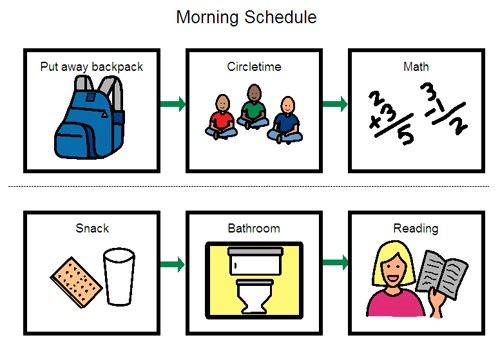
* Visual Schedules for what the morning will look like, actually great for all students too.


* Other students telling child vs adult directions or holding their hand to walk
* Lap weights for sensory feedback (fill tube socks with corn or rice)
* Noise canceling headphones
* Tents or sheet over table for calm area with a pillow inside
* Being allowed to roam or hold a preferred item noncontingently during activities
* Painters tape on carpet for giving boundaries or places to sit
* During group activities, try to have some part hands on such as puppets
* Intersperse the time with various activities to provide preventative sensory activities, i.e. carry a heavy box or chair to their seat or next location, wear ankle or wrist weights, pull self on scooter board to next location, jump on a yoga ball or jump hard prior to next activity, wheel barrel walk, etc. These are easy to do during transitions to embed sensory preventative activities.
* Communication – Teach them prior to the behavior what words to use, i.e. break, lets walk, go, ipad, tap on shoulder, etc. Goal is to have them communicate prior to using problem behavior.

Friday, November 18, 2016

Friday, October 7, 2016

Please Welcome Victoria Mitchell, M.S. OTR/L

Please welcome the newest member of our Team, Victoria Mitchell Pediatric Occupational Therapist. If you, or anyone you know has a child in need of occupational therapy we currently have openings, including after school hours. Please share!

Victoria Mitchell, M.S., OTR/L
Victoria graduated with a Master of Occupational Therapy from the University of South Alabama in 2011. During her time in adult rehabilitation, she was able to work with a variety of conditions, including stroke, dementia, amputations, and neurological disorders. In 2012, she was able to transition into pediatrics and has been working in out-patient pediatrics since. Vicky enjoys and has talent for working with children who have neurological, genetic, and sensory conditions and/or deficits. She also has a passion for handwriting and is currently in the process of becoming handwriting certified through the Handwriting Without Tears Program.