Showing posts with label speech therapy. Show all posts

Friday, August 18, 2017

Picture Exchange Communication System (PECS)


Image result for PECS


Speech Pathologists at Therapyland are trained in the Picture Exchange Communication System (PECS). PECS is a teaching protocol based on behavior analysis that focuses on functional communication. It was developed by Lori Frost, MS, CCC-SLP and Andy Bondy, PhD. PECS is taught in phases. In the first phase, children are taught to request by exchanging a picture with a communication partner. Children are taught to initiate the interaction independently, not wait for their communication partner to start the interaction. In later phases, they request using more complex phrases, pair vocalizations with the requests, ask questions, and make comments. PECS can be used with children with a variety of disabilities. Current evidence indicates that PECS does not inhibit speech, but may increase speech production in some children. Some children who use this system later transition to a speech generating device.

For more information on PECS

Monday, April 10, 2017

THE BIG PICTURE: Focusing intervention for autism


Gail J. Richard, PhD, CCC-SLP, a former chair, professor emeritus and director of The Autism Center at Eastern Illinois University, emphasizes the importance of incorporating all aspects of development when targeting treatment - including not only the speech profile but also social, sensory, and motor. These separate factors all play different imperative roles throughout the child’s life; roles that may affect how they function in the real world. For example, furthered education may be effected by a decreased ability to perform executive functions tasks (initiate, plan, organize materials, and manage time and academic expectations). As stated by Richard, “their strong intellectual potential cannot be realized without an infrastructure to facilitate their success.” (Richard G.J., 2017). By assessing all aspects of development, therapists can focus their intervention on the big picture and gain the best results possible. At Therapyland, all areas of discipline approach their treatment goals with this theory in mind. Whether it’s physical, occupational, language, speech, feeding or behavioral, the target is consistent with the ‘big picture’ – generalizing skills with each child’s unique ‘real world’ factor in mind. The vast collaboration amongst disciplines further facilitates this objective.

To dive more into this educational read, check out the full article ASHA leader published in their latest magazine: http://leader.pubs.asha.org/article.aspx?articleid=2615520&resultClick=3

Monday, January 9, 2017

What is ABA? continued by Sandi Rivers, M.Ed. BCBA

III. The Building Blocks

A: Antecedent-the environment, the events or the behavior that precedes the Behavior of Interest, or Target Behavior. Also known as the "Setting Event," the antecedent is anything that might contribute to the behavior. It may be a request from a teacher, it might be the presence of another person or student, or even a change in the environment.

B: Behavior-what the student does. This is sometimes referred to as "the behavior of interest" or "target behavior.” It is the behavior that you are focusing on, that is either pivotal (leads to other undesirable behavior, or contributes to other undesirable behaviors) a problem behavior that creates danger for the student or others, or a distracting behavior, that removes the child from the instructional setting or prevents other students from receiving instruction.

C: Consequence. It is the outcome that is reinforcing for the child (the FUNCTION / EATS), so it in turn reinforces the problem behavior. Is the consequence that the child is placed in time out, therefore avoiding a task? Does the parent give the child a preferred item or food, in order to stop the behavior?

IV. So Now What? ANTECEDENT STRATEGIES

* Pairing is MOST IMPORTANT!! RAPPORT has to be built and the child should desire to come to the staff member and/or place. Special Reinforcing boxes with preferred items for the child can be presented immediately upon drop off.

* May be helpful to interview the parents in re: to what the child’s preferences are and to send in favorite items with their child.
* Reward Systems to set expectations. Token boards or reinforcing on a schedule.
* Seating priority for easier redirection and to provide more frequent reinforcement.
* Visual spot to sit on or in for a chair, i.e. special carpet piece, rubber circle, bubble seat, sit spots, yoga ball to sit on.
* A fidget to hold or for putting in mouth so hands are busy (amazon and ARK therapeutic)
* Choice making – empowers the child, i.e. do you want to sit in the blue or red chair, etc.
* If/then visual supports (premack principle or grandma’s rule)

* Timers for how long to participate or before receiving a desired item 
* Reinforcer choice boards, easily made on google images.
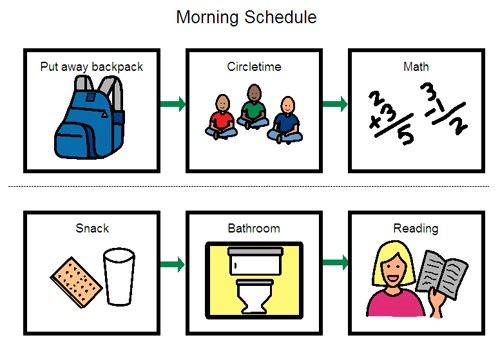
* Visual Schedules for what the morning will look like, actually great for all students too.


* Other students telling child vs adult directions or holding their hand to walk
* Lap weights for sensory feedback (fill tube socks with corn or rice)
* Noise canceling headphones
* Tents or sheet over table for calm area with a pillow inside
* Being allowed to roam or hold a preferred item noncontingently during activities
* Painters tape on carpet for giving boundaries or places to sit
* During group activities, try to have some part hands on such as puppets
* Intersperse the time with various activities to provide preventative sensory activities, i.e. carry a heavy box or chair to their seat or next location, wear ankle or wrist weights, pull self on scooter board to next location, jump on a yoga ball or jump hard prior to next activity, wheel barrel walk, etc. These are easy to do during transitions to embed sensory preventative activities.
* Communication – Teach them prior to the behavior what words to use, i.e. break, lets walk, go, ipad, tap on shoulder, etc. Goal is to have them communicate prior to using problem behavior.

Thursday, November 10, 2016

What is feeding therapy?


 My son doesn’t like green beans.  According to my husband, it is because he is smart.  But what happens when your child doesn’t like any food that is green…or orange…or too soft…or too hard?  Is your child just a picky eater, or could there be a bigger problem?

According to The American Speech-Language-Hearing Association feeding and swallowing disorders are described as “problems gathering food and getting ready to suck, chew, or swallow it.”  Signs and symptoms of feeding or swallowing disorders include failure to accept different textures of food, long feeding times (over 30 minutes), coughing or gagging during meals, less than normal weight gain or growth, and difficulty chewing.  If you notice these symptoms in your child, it might be time to discuss your concerns with your pediatrician. 

What happens next?  If feeding therapy with a speech-language pathologist is recommended, an evaluation is completed to look at movement and strength of muscles used during eating as well as an observation of eating to examine posture, behavior, and oral movements during chewing and swallowing. If therapy is then recommended, treatment may target increasing strength of mouth, increasing lip and tongue movements, improve chewing ability, accepting a variety of foods, and/or improving ability to drink from a cup or straw.

Our goal is to have happy, healthy kids who are able to enjoy the social and nutritional benefits of meals with families without the stress!


Thursday, November 3, 2016

Is Screen Time Affecting Your Child?

Screen Time and the Young Child

Computers and electronic devices are a huge part of our daily lives.  They are a huge part of our kid’s lives as well.  But when should these items become a part of our lives and how often should they be allowed? Babies have a curiosity for the light and sounds of iPads and phones. One-year olds are getting tablets for their birthdays.  The 2013 Zero to Eight study commissioned by Common Sense Media showed that 38 percent of infants younger than age two use mobile devices like smartphones. What does this exposure mean for our little ones?

Recent studies have shown that screen time can have an impact on typical language development in small children.  It showed that the more television children under two watch, the less words they are able to understand and communicate. This includes televisions on as background noise.  Other studies have shown that when technology is used as “play”, the amount of expressive language used by the parent decreases as opposed to when they play using simple toys or books. With that being said, should you completely limit all screen time and media time?  Is that realistic in today’s world?

Up until recently, the American Association of Pediatrics recommended avoidance of screen time for children under 2 and 1-2 hours a day for older children. But they are currently changing their guidelines.  They have stated, “In a world where ‘screen time’ is becoming simply ‘time,’ our policies must evolve or become obsolete.” So what are their recommendations?

Current recommendations include:
·        Setting limits at every age. AAP has said that limited screen time continues to be best for children under 18 months.  FaceTime with Grandma? It is completely fine. For children 18 to 24 months, limit screen time to high-quality programing/aps. Children older than 2 should limit screen time to one hour or less a day.
·        Avoiding displacement.  Strive to maintain time for play, conversation, and creativity.
·        Address digital etiquette.
·        Engage in media use together. Adult interaction continues to be crucial for young children. Discuss what is seen on the screen with your children to model more language and joint attention.
·        Create media-free zones. Take time away from your devices.
·        Model media behaviors. It is amazing what children pick up from just simple observations.

Technology isn’t going away.  We just have to find a balance to help young children learn how to handle technology in their lives as well as encourage social and communicative development.


Thursday, October 27, 2016

Please Welcome Carly Morris, MA CCC-SLP

Carly received her Bachelor’s in Communication Sciences and Disorders from the Pennsylvania State University, followed by a Master of Arts in Speech and Hearing Sciences from the University of Illinois, Urbana-Champaign.
As a practicing Speech-Language Pathologist, Carly has treated a variety of speech and language disorders and symptoms including autism, Down syndrome, genetic disorders, neuro-motor disorders, childhood apraxia of speech, brain injuries, as well as, stuttering. Carly is P.R.O.M.P.T., Beckman, and Kauffman trained. She is particularly passionate about feeding and swallowing disorders, sensory, behavioral, and oral-motor based disorders. Carly’s experience includes medical management of feeding disorders and coordinating teams to include a gastroenterologist (GI) doctor, nutritionist, dietician, pediatrician, and psychologist to improve oral feeding. She is also an orofacial myofunctional therapist who coordinates care with orthodontists to create programs to eliminate tongue thrust during swallowing.
Carly has over 8 years experience assisting the management of a pediatric private therapy practice. She has proven skills in leadership, management, and mentoring other clinicians in the field. Carly truly enjoys coordinating care with parents and teams to create goals focusing on daily independence and functioning of the child.

Tuesday, October 11, 2016

New York Times-When Do you Worry About a Picky Eater?


Dr. Peri Klass sums up feeding difficulties perfectly in this article. We offer a dynamic team approach to combat feeding difficulties in children. This team includes a speech therapist specializing in feeding, an ABA therapist, a GI doctor, the child's pediatrician and dietitian. For more information, please contact Carly Morris-carly@therapyland.net.

Friday, October 7, 2016

Toddler Talk

Speech is an important milestone in toddlers. Toddlers usually begin using one- two word phrases at this stage. There are several things that parents and caregivers can do to encourage speech.

Toddlers understand and say nouns before other parts of language. Identifying nouns with your child is the best way to start speech. You can build vocabulary in almost everything you do with children, simply by talking to them. While dressing them (or as they are dressing themselves) identify shirt, pants, socks, shoes, say left foot and right foot when putting on their shoes. While at the grocery store, identify common food items, apples, juice, crackers, etc. While driving in the car, ask your child “what do you see?” and model responses such as “I see trees and the road” or “I see a stop sign and a car next to us.” Descriptive words are important when building a vocabulary. When talking with your child, use adjectives. You can say, “I like your green shirt”, “Let’s get in the blue car”, “That tree is tall”, “The kitten is little”, etc.

In addition to working on receptive language, you can encourage talking by modeling words for your child. If they show signs of hunger, model “eat” and try to have them imitate the word. If they want to be picked up, model “up” and try to have them imitate the word.

Typically your child’s first words are simple. At dinnertime, say “Eee” before giving them food, withhold for a moment to encourage them to imitate the sound to request “eat”. When playing with a ball, say “ba” before throwing them the ball. The motivation of playing should encourage them to imitate the sound. Shortening words so that children are able to say them is important. Instead of encouraging them to say “fire truck”, first work on “tuck”. Simplifying words can be helpful so that children can more easily imitate. Shorten sentences as well. Instead of saying, “The baby is crying”, encourage your child to say, “Baby cry”. Instead of asking them to say “pick me up, please”, ask them to say “up peas”. Then follow up with a model of the correct production of the word or sentence.

Finally, reading is a great way to encourage speech and language. While reading books, describe the pictures and ask questions. In addition, ask them to identify and point to pictures in the book. This will keep children engaged during book reading.